I’m a fan of sales reports.
Even when they don’t fully reflect one’s own daily reality, they are useful benchmarks and a mirror for reflection.
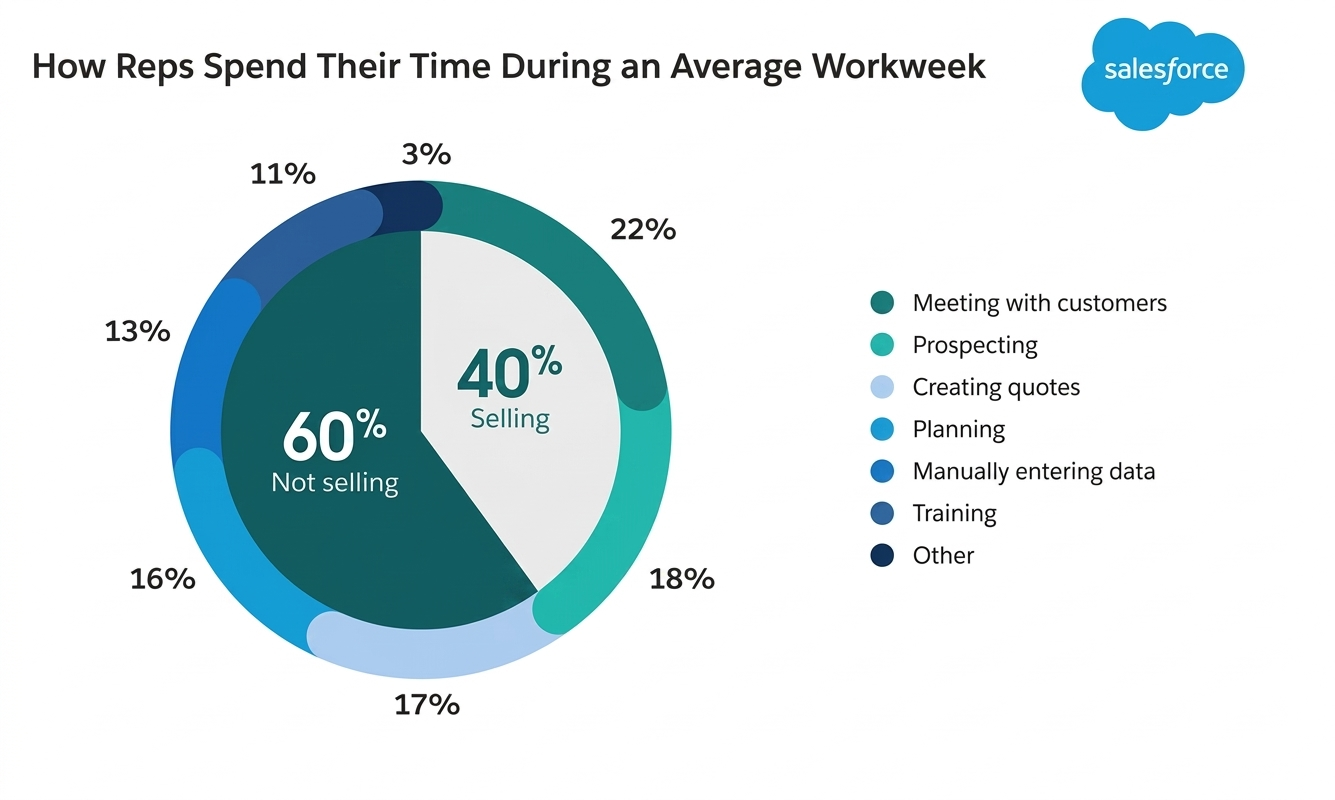
Here, one of the most striking data points is this one:
Salesforce reports that sales reps spend only 40% of their time actually selling.
Let that sink in.
It means that around 60% of a sales team’s time is spent on everything else, but not actually selling.
In a business environment where sales cycles are getting more complex, margin pressure is constant, and hiring more people is often not an option, this should trigger a serious question, and an immediate corrective plan, in every leadership team:
“Are we really making the best use of our most expensive resource, sales time?”
More often than not, when I raise this item with sales leaders, their immediate reaction is to focus on how to increase selling time.
And that is a good thing. But not the best thing to do first.
What often happens, however, is that the only response is to expect more selling time (in value, i.e. increasing the number of hours), rather than a deep analysis of what can be delegated, what can be eliminated, or what can be optimized.
In that case, it’s more a quick fix rather than a structural solution.
But here’s where it gets more interesting.
That 40% of selling time does NOT mean 40% of effective selling time.
It simply means time allocated to selling activities.
- Not whether that time is well used.
- Not whether it leads to revenue.
- Not whether it moves deals forward.
So the real question is not: “How much are your sales reps selling?”
It’s: “How effectively are they selling when they do?”
And that changes everything.
Because effectiveness is driven by a few critical levers:
• Clarity and discipline around ICP
• Strength of sales and negotiation skills
• Ability to build real connections with decision makers
• Focus and prioritization across the funnel.
Without these, even “selling time” can be wasted time.
Now take a step back.
If only 40% is selling time, and only a part of that is truly effective, it is not unrealistic to end up with something closer to 20% real productive commercial impact.
In short: a sales team of 10 people, but a commercial engine designed to generate revenue, effectively reduced to just two.
That is not a hiring problem.
It is an effectiveness problem.
And before increasing pressure on teams, or adding headcount, the real work is improving how the sales engine actually performs.
Because that is ultimately the job of sales leadership:
not just managing activity, but creating the conditions where sales time turns into revenue.
💡 In your organization, where do you feel the biggest time leakage happens in the sales cycle?
(Source: Salesforce State of Sales report. Used for commentary and analysis purposes only. All rights remain with Salesforce.)

